Longer lives create opportunities that earlier generations could hardly imagine: more years for work, family, travel, service, learning, creativity, and purpose.
They also give financial decisions more time to interact. For example, a tax decision can change retirement liquidity. A care need can alter family roles and legacy. The loss of a spouse always changes taxes, and can change income, housing, and support as well.
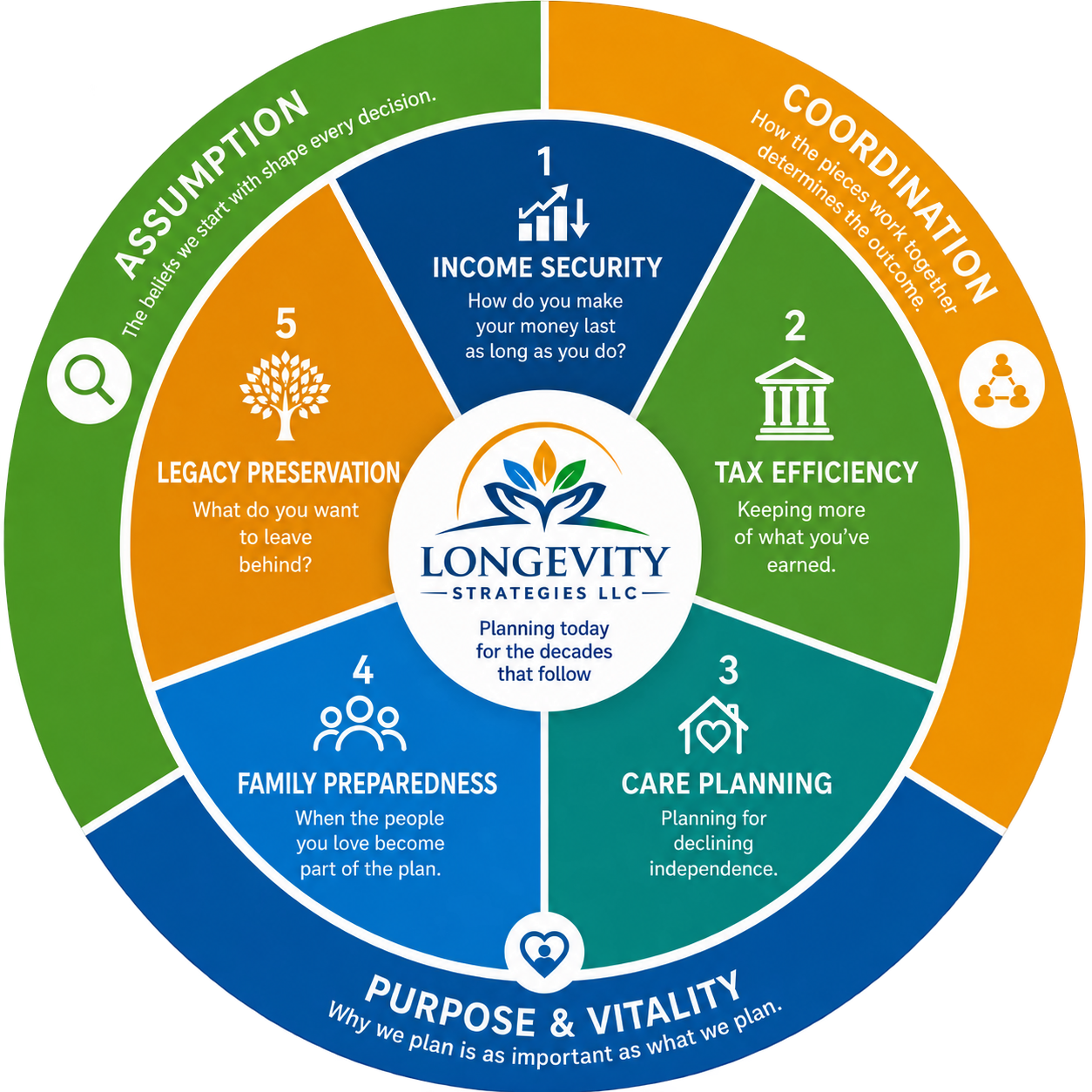
Financial planning by definition involves money, and money-based frames can narrow our focus to quantitative, mathematical elements of a decision, rather than their ethics and human purpose. To set a comprehensive planning frame worthy of that description, Longevity Strategies looks across five connected planning areas — income, taxes, care, family, and legacy — and asks three questions: What are we assuming? What else does this affect? What is the plan intended to make possible?
The purpose is not simply to protect against what might go wrong. It is to help make sure your resources, decisions, and relationships continue to support the life you want to live.
Five readiness areas. Three questions. One coordinated plan.
Where do we look? Income. Tax. Care. Family. Legacy.
How do we look? What are we assuming? What else does this affect? What is the plan intended to make possible?
Start with the free Longevity Readiness Self-Check. If useful, continue with a guided Longevity Readiness Assessment™ to identify strengths, gaps, and connections that may deserve deeper planning.

The Five Planning Areas
RUNNING OUT OF MONEY IS ONLY ONE WAY A LONG RETIREMENT CAN fall short of delivering the life you dream of.
Longevity planning looks at five connected topics:
Income Security — Will your money support the life you want for as long as you may need it?
Tax Efficiency — Are taxes being managed across retirement, rather than one year at a time?
Care Planning — How can changing health be planned for without surrendering choice and independence?
Family Preparedness — Will the people around you know what to do?
Legacy Preservation — Will what you built, valued, and intended survive you?
The guided Assessment also considers Purpose & Vitality Risk: whether your plan supports health, independence, connection, and a life worth looking forward to.
The Three Questions
ACROSS ALL FIVE topics, WE LOOK FOR WHAT MAY BE EASY TO MISS WHEN EACH SUBJECT IS CONSIDERED ALONE.
What are we assuming?
What else does this affect?
What is the plan intended to make possible?
These questions bring Assumptions, Coordination, and Purpose & Vitality into the planning conversation without asking you to learn a new vocabulary first.
The Assessment
THE LONGEVITY READINESS ASSESSMENT™ IS GUIDED 45-MINUTE EDUCATIONAL REVIEW OF HOW THE PIECES FIT TOGETHER PROVIDED AT NO CHARGE AND WITH NO OBLIGATION TO PURCHASE ANY PRODUCT OR SERVICE.
It looks at Income Security, Tax Efficiency, Care Planning, Family & Support Preparedness, and Legacy Preservation. It also considers whether assumptions, documents, advisors, family roles, and life goals are coordinated.
We are looking not only for gaps, but for connections. The Assessment produces a preliminary score, highlights possible red flags, and helps decide whether deeper planning may be worthwhile.

Who We Help
LONGEVITY STRATEGIES WORKS ESPECIALLY WELL WHEN RETIREMENT DECISIONS CROSS FINANCIAL, FAMILY, CARE, OR LEGACY QUESTIONS.
executives and professionals approaching retirement;
business owners thinking about transition, income, tax, and legacy;
couples who want to coordinate income, care, survivor planning, and family roles;
individuals navigating retirement, widowhood, divorce, or financial independence;
families facing care decisions for parents, spouses, partners, or adult children;
people without a traditional family safety net who need clear authority, backup decision-makers, and support systems.

Meet Your Advisor
Meet Ardal Powell
Ardal Powell, MA, PhD, CLTC®, ChFC®, brings an unusual combination of scholarship, entrepreneurship, and financial planning experience to longevity planning.
Before entering financial services, he built an international business and became widely known as a scholar, author, teacher, publisher, and maker of historical musical instruments. Today he applies the same analytical rigor and long-term perspective to helping clients think through income, taxes, care, family dynamics, legacy, and the practical consequences of longer lives.

Let's Get Started
THE SELF-CHECK IS THE START, NOT THE PLAN.
Begin with the free Longevity Readiness Self-Check. If your answers suggest that a guided review may be useful, the next step is a 10-minute Fit Call, also at no cost. There is no obligation to continue.
*Clients who desire ongoing financial planning and sign an agreement for our services, will not be charged the Advisor portion of an AUM Fee on any money we manage through our Investment Advisory Services. Note other fees such as Eagle’s fee, money manager fees, and custodial fees will still be charged. See Eagle’s Form ADV and the agreements you sign for more details. Both Financial Planning and Advisory Services are offered through Eagle Strategies LLC, a Registered Investment Adviser.