We are looking not only for gaps, but for connections.
A household can appear well prepared in one area and still have a vulnerability somewhere else. For example:
a tax strategy may improve one outcome while reducing liquidity elsewhere;
estate documents may be current while family roles remain unclear;
resources may be available for care without agreement about who would organize it or make decisions.
Having the pieces is not the same as having a coordinated plan.
Investments, retirement income, taxes, insurance, legal documents, care arrangements, and family expectations can each look reasonable on their own. Longevity Strategies asks how a decision in one area changes the others.
The Assessment gives you a structured way to decide whether deeper planning may be valuable. The purpose is not simply to protect against what might go wrong. It is to help make sure your resources, decisions, and relationships continue to support the life you want to live. It is not a sales meeting, financial plan, investment proposal, or product recommendation.
What it is
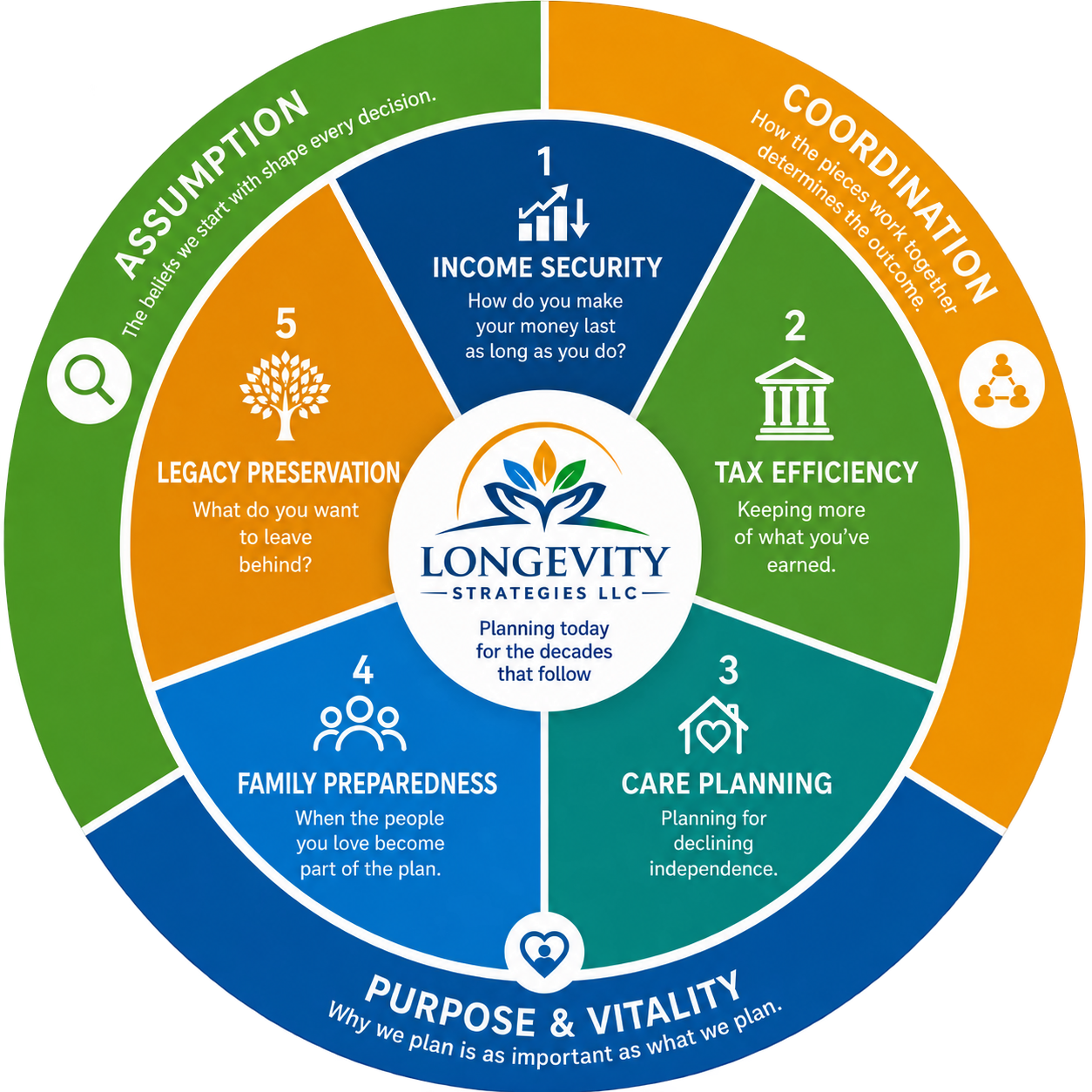
The Assessment is a guided conversation that helps identify strengths, gaps, and possible red flags in your long-life planning, and to check that your resources, decisions, and relationships continue to support the life you want to live. It is designed for people who want to understand how income, taxes, care, family responsibilities, decision-making, and legacy fit together.

What it is not
The Assessment is not:
a financial plan;
an investment recommendation;
a tax opinion;
legal advice;
an insurance recommendation;
or a substitute for a paid planning engagement.

Five scored categories
Income Security
Tax Efficiency
Care Planning
Family & Support Preparedness
Legacy Preservation

Additional overlays
Assumption Overlay — What are we assuming
Coordination Overlay — What else does this affect?
Purpose & Vitality Overlay — What is the plan intended to make possible?
The overlays are a vital component of long-life planning because a plan can be technically sound in separate parts and still depend on assumptions or interactions that deserve attention.

What you receive
At the end of the Assessment, you receive:
a preliminary score across the five planning categories;
an overall readiness level;
possible red flags;
a view of Assumptions, Coordination, and Purpose & Vitality;
and a suggested next step.
The next step may be no further action, education and follow-up, a limited Longevity Risk Audit, or a more comprehensive Longevity Blueprint.

Who should consider it
Professionals, executives, business owners, couples, and individuals:
approaching retirement;
recently retired;
concerned about income;
concerned about taxes;
helping aging parents;
worried about care costs;
supporting adult children;
widowed, divorced, remarried, or single;
no clear successor decision-maker;
outdated estate documents;
significant IRA, 401(k), pension, annuity, or real estate assets;
want to make longer life purposeful and secure.